FAQs
No items found.

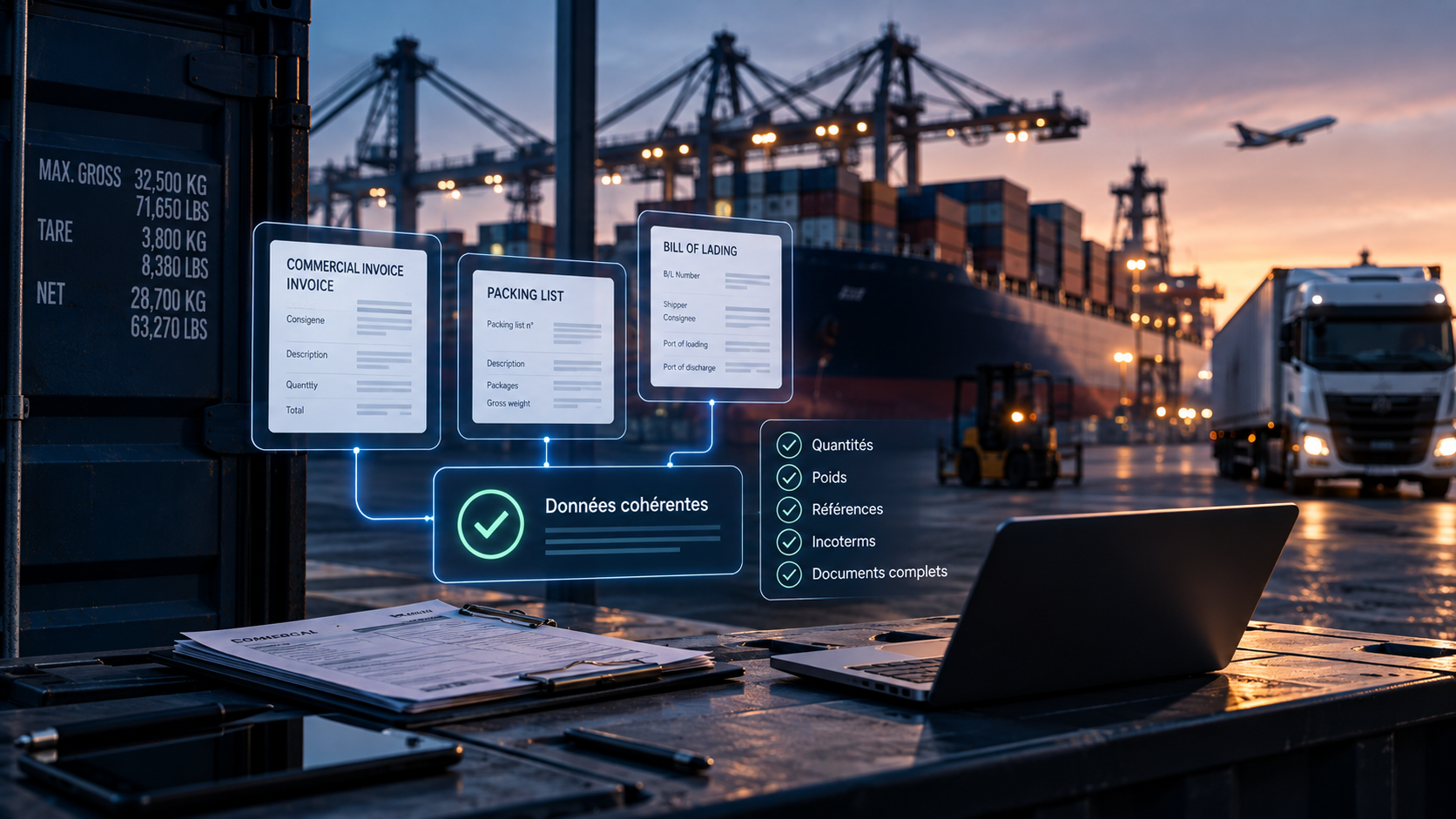
A set of documents may be complete without actually being in compliance. A commercial invoice is included. The packing list has been received. The transport document is available. The certificate of origin is included in the file.
However, the information may be inconsistent: a discrepancy in quantity between the invoice and the packing list, a weight that does not match the shipping document, a difference in country of origin between two supporting documents, or an HS code that is difficult to reconcile with the description of the goods.
The issue, therefore, is not merely to verify that the documents are present. It is to verify that the information they contain is consistent, complete, and in compliance with applicable rules.
That is precisely the goal of automated document compliance.
In the fields of transportation, logistics, customs, and international trade, this marks a significant shift: moving from checking documents one by one to reviewing the entire file. This approach relies in particular on document extraction, information reconciliation, business and regulatory checks, and, when necessary, human validation.
Automated document compliance refers to the use of technologies that automatically verify documents and the information they contain against rules, standards, and other documents in the same file.
The goal is to identify, before they become problematic:
However, document compliance should not be confused with regulatory compliance in the broader sense.
A system monitors the documentary evidence related to a regulatory requirement, without, however, making the final legal or regulatory decision on its own.
This is particularly important in customs operations. A control system can detect an inconsistency, flag a missing document, or recommend an HS code, but the validation of certain decisions remains the responsibility of the expert.
This is one of the key distinctions. A document that is perfectly legible and correctly filled out may still be inconsistent with the other documents in the file.
Let's take a simple example:
The three pieces of information were successfully extracted. But which one should be selected? The extraction did not solve the problem. The consistency check still needs to be performed.
Document compliance truly begins when the system is capable of reasoning about the relationships between pieces of information.
International transactions are rarely based on a single document.
A single shipment involves a commercial invoice, a packing list, a bill of lading, a CMR or AWB, a certificate of origin, customs documents, a freight invoice, proof of delivery, and regulatory documents. The same data—such as item descriptions, quantities, weights, values, currencies, and Incoterms—appears multiple times in different formats.
This proliferation creates a specific problem: errors often occur across documents rather than within a single document.
Here are a few examples:
These discrepancies lead to requests for clarification, delays, billing errors, disputes, or hold-ups during customs procedures. The challenge lies not so much in finding the information as in determining whether the information found is reliable in the context of the procedure.
Effective automation is not simply a matter of scanning documents and extracting their data. The process can be illustrated as follows:
Capture → Identify → Extract → Normalize → Reconcile → Verify → Qualify → Recommend → Monitor
Each step plays a different role.
Documents may come from various sources:
The goal is to gather the parts needed for inspection without increasing the number of manual steps.
The system automatically determines the type of each document:
This classification then makes it possible to apply the appropriate controls for each type of document.
Documentary AI identifies relevant information:
This data is structured so that it can be used by business processes.
When two documents express the same information in different ways. A reference may be presented with or without a separator. A quantity may be formatted differently. A unit may vary. A date may be written according to different conventions. Standardization makes this information comparable before performing the checks.
This is where the file review truly begins. The system cross-checks the information from the various documents and identifies discrepancies. For example, it can compare:
Document reconciliation is thus one of the essential building blocks of document reliability.
The data is then evaluated against various types of rules:
In a customs context, this can, for example, help identify an inconsistency between the description of a good and its classification, or detect the potential absence of a required supporting document.
Not all differences are necessarily mistakes.
A difference in weight may be normal, depending on the type of weight being considered. A date may differ because the documents correspond to different stages of the process. The system must be able to contextualize the discrepancy, rather than simply flagging that a value is different. This is a key difference between a simple field comparison and a true document verification.
Once the anomaly has been identified, the system can assist the operator by indicating:
The goal is not to generate more alerts, but to allow teams to focus on situations that truly require their attention.
Different information technologies do not address the same needs.
OCR remains a fundamental building block. It enables the recognition of text, dates, amounts, weights, and references. However, reading “12,500 kg” does not necessarily mean understanding whether it is a gross or net weight, nor does it verify that this value matches the one listed on the packing list or bill of lading.
IDP goes a step further by classifying documents, extracting data, and structuring it.
But extraction alone does not guarantee their reliability. Document compliance therefore comes into play at a higher level: it uses the extracted data to verify the file.
Automated document compliance covers several categories of controls.
The system verifies that the required documents are present.
Examples:
In a customs case, this detection may occur before the case is forwarded in order to minimize delays further down the process.
Certain documents must meet specific requirements:
This is the primary focus of documentary reconciliation.
The system can check for discrepancies between:
Information can also be checked against applicable standards or rules. In the customs field, this may particularly involve classification, origin, required documents, or certain regulatory requirements.
Compliance isn't just about regulations. A company may also want to monitor:
Document compliance thus becomes a true quality control measure for the data before it is used in the business process.
The system extracts data from both documents and reconciles:
A discrepancy is identified and presented to the operator along with its context.
This is a particularly representative use case for document reconciliation.
A transportation file may require several documents.
Automation can check:
The goal is to identify problems before the operation begins, rather than once it is already underway.
In a customs context, the system can cross-reference commercial and regulatory documents to identify:
The Customs Compliance Engine (CCE) is designed precisely for this purpose: to verify, reconcile, and make recommendations before data is transmitted to the declaration tools. It does not replace the customs declarant.
When a transaction requires specific certificates or supporting documents, the automation system verifies that they are present and reconciles the information they contain with the other documents in the file.
A shipping invoice can be reconciled:
The system highlights discrepancies that require verification.
International transactions involve a particularly high volume of documentation: invoices, shipping documents, certificates, declarations, supporting documents, and bank documents may all be part of the same transaction.
Documentary analysis, therefore, involves bringing these different sources into dialogue with one another rather than analyzing each one separately.
Effective document automation shouldn't just generate a list of errors. It should help you understand why an anomaly is being flagged. For example:
The weight listed on the invoice differs from that on the bill of lading.
This information is insufficient.
The operator must be able to understand:
This is particularly important in regulated environments, where decisions must be explainable and verifiable. The value of a document compliance solution therefore lies as much in the traceability of the verification process as in the detection itself.
No, and that's generally not the relevant goal.
Some tasks are very easy to automate:
Other situations require more judgment:
The most robust approach, therefore, relies on a human-in-the-loop system.
The system can:
detect → monitor → alert → recommend
The expert may:
analyze → decide → approve.
The goal is not to replace expertise. It is to use it where it adds the most value.
Document compliance is an important step, but it can be viewed as part of a broader approach: document reliability. The difference is simple.
Compliance primarily seeks to answer the question:
Do the information and documents comply with the applicable rules?
Document reliability raises a related question:
Is the data from the file sufficiently reliable, consistent, complete, and usable to be incorporated into the business process?
This approach combines:
We are thus gradually moving from:
document → data → verified data → reliable data → business action
This is one of the foundations of Trade Document Intelligence : no longer simply processing documents, but transforming the information they contain into coherent and actionable data.
Document automation is only valuable if the data it generates is used by the systems and teams that actually carry out the process. Depending on the organization, this may include:
The goal is not necessarily to create a new document silo. Rather, it is to add a layer of control and document intelligence between incoming documents and business processes. The system receives the documents, extracts the information, performs the necessary checks, flags exceptions, and forwards the reliable data to the relevant system.
This approach measures automation at the process level rather than solely at the data extraction level. The right metric is not just the extraction rate, but the ability to actually process the file all the way through.
Digitizing business processes does not eliminate the problem of document management. It merely shifts it. The more companies automate their processes, the more they depend on the quality of the data that feeds them.
Incorrect data automatically entered into an ERP, TMS, or customs system can simply cause an error to spread more quickly. That is why data capture automation must be accompanied by automated checks.
In fact, the market is moving in this direction: classification, extraction, structuring, and even human validation are gradually becoming core capabilities of document management solutions. The key differentiators are shifting toward process automation, workflows, and reasoning and orchestration capabilities.
So the question is no longer just:
How can I extract data from a document more quickly?
It becomes:
How can we ensure that the extracted data is consistent and reliable enough to trigger an action?
Automated document compliance addresses a very real problem: a file may contain all the necessary documents but still lack consistent and compliant information. Automation changes the logic of the verification process:
capture → extract → reconcile → verify → qualify → recommend → supervise
OCR reads. IDP extracts and structures. Reconciliation compares. Compliance checking verifies the rules.
And document reliability goes even further: it transforms this information into consistent, verified data that can be used by operations. For those involved in transportation, logistics, customs, and international trade, this development is essential.
The real challenge is no longer about processing more documents. It’s about being able to trust the information they contain. And that’s precisely where Trade Document Intelligence comes in.