FAQs
No items found.

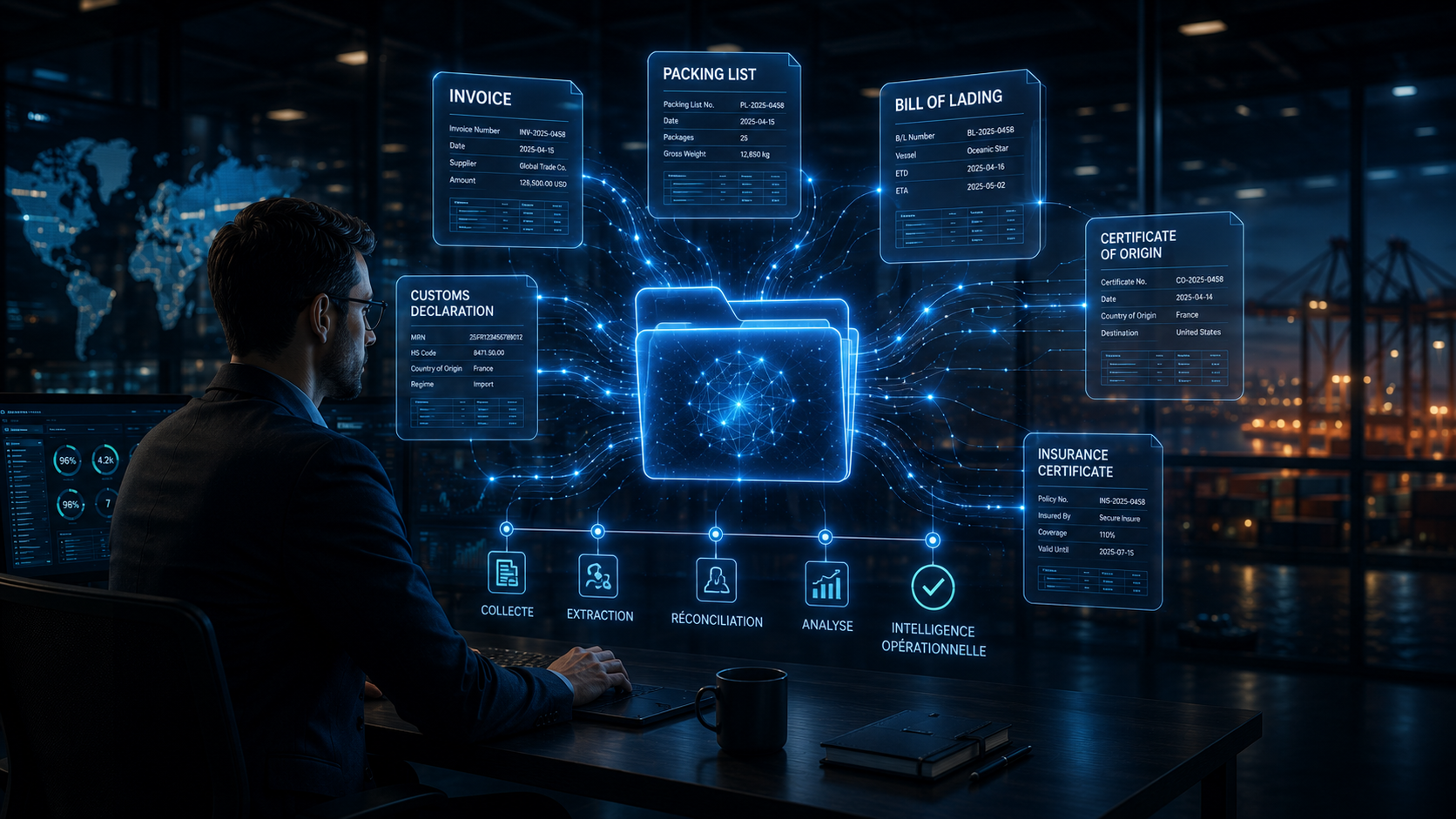
For several years, document automation has focused on a single goal: extracting data from documents.
OCR made it possible to digitize the information. Intelligent Document Processing (IDP) then automated document classification, data extraction, and data structuring.
These technologies have profoundly transformed document management operations.
But in the fields of transportation, logistics, customs, and international trade, one reality remains: operational errors generally do not stem from a single document.
They occur when multiple documents describe the same transaction in different ways.
The weight may differ between a commercial invoice and a bill of lading. The quantity may differ between a packing list and a customs declaration. A required document may be missing even though the other documents in the file are perfectly valid.
The real challenge, therefore, is no longer just reviewing documents. It also involves verifying the consistency of the documents across an entire file.
That is precisely the role of Trade Document Intelligence.
Trade Document Intelligence is a business intelligence layer specialized in documents related to transportation, logistics, customs, and international trade. It leverages the capabilities of Document-Centric Agentic to understand, reconcile, verify, and analyze the information contained within an entire set of documents.
IDP extracts and structures data. Document-Centric Agentic provides reasoning and orchestration capabilities for document-based processes. Trade Document Intelligence applies these capabilities to the specific challenges of international trade to reconcile information, verify its consistency, and assist business teams in their decision-making.
For a long time, document management solutions were primarily distinguished by their ability to accurately extract data from a document.
Today, several features have become industry standards:
These capabilities remain essential. They form the foundation of any advanced document processing solution.
But the market is changing. Differentiation is gradually shifting toward three additional layers:
It is within this evolution that Document-Centric Agentic emerges: an approach in which AI no longer merely reads or extracts information from a document, but can reason about entire document-based processes.
Trade Document Intelligence leverages these capabilities to address the specific needs of transportation, logistics, customs, and international trade. Its role is to understand the relationships between multiple documents, verify their consistency, consolidate information, and support business teams in their decision-making.
The difference, therefore, does not lie in a contrast between IDP and Trade Document Intelligence. It lies in the shift from an approach focused primarily on extracting information from a single document to one capable of analyzing an entire set of documents.
The IDP effectively answers an initial question: What does this document contain?
In international trade transactions, an additional question becomes essential: Is the information contained in the entire file consistent, complete, and actionable?
An international shipment generates a large number of documents:
Taken individually, each of these documents may be perfectly valid. However, there may be discrepancies between them.
Some common examples:
In practice, a large part of the work done by the operations, customs, and finance teams involves identifying these discrepancies.
The problem, therefore, is not just reviewing the documents, but ensuring consistency across the entire case file.
Trade Document Intelligence is a business intelligence layer specializing in documents related to transportation, logistics, customs, and international trade.
It focuses on the business file rather than on individual documents. Its purpose is not merely to extract data. It aims to:
Trade Document Intelligence leverages the capabilities of Document-Centric Agentic to analyze an entire file and maintain its context as new information becomes available.
It does not replace ERP systems, TMS systems, or customs platforms.
It acts as a layer of control and document intelligence between documents, business teams, and operational systems.
To verify the consistency of an operation, it is necessary to consider the entire file.
That is precisely the role of the Living Dossier.
A shipping file is constantly changing. New documents arrive. Approvals are granted. Corrections are made. Operational events occur.
The Living Dossier is a dynamic representation of this reality.
Each document gradually enhances the overall understanding of the transaction. Each document review improves its level of reliability. Each reconciliation helps build a consolidated view of the transaction.
Unlike traditional archival processing, which focuses on individual records, the Living Dossier preserves the historical context of the operation over time.
A new invoice, a corrected version of a packing list, or the receipt of a certificate can thus add to the file and trigger new checks.
The file then becomes the unit of analysis for Trade Document Intelligence.
Document consistency does not depend on a single check. It requires several complementary levels of verification.
Cross-document reconciliation involves automatically comparing the information contained in different documents.
Examples:
The goal is to identify inconsistencies among several documents describing the same operation.
The goal is to verify that the documents are consistent with the actual events of the operation.
Examples:
This verification allows us to compare the information in the documentation with the actual operational situation.
This level of control is based on external standards.
Examples:
The information contained in the file can thus be cross-checked against external sources to identify certain anomalies or regulatory requirements.
This step involves comparing the information in the documents with the company's internal databases.
Examples:
A shipping invoice can, for example, be compared with the negotiated rate terms to identify any discrepancies.
Expert reconciliation relies on building on the decisions and corrections made by the business teams.
Human expertise thus becomes a key component of the document control system.
Operators' decisions, validations, and corrections can gradually enrich the available context and help improve the relevance of future checks.
Language models have significantly improved document understanding.
Today, they make it possible to extract complex information without having to rely on rigid models or templates.
However, understanding a document does not guarantee an understanding of a procedure.
A model can identify a piece of information. It cannot necessarily verify that it is consistent with the other ten documents in the file, with the company's business rules, or with the applicable standards.
Document review requires, in particular:
Value, therefore, does not lie solely in the model's intelligence. It lies in the system's ability to analyze the entire body of documentation and retain the evidence that supports its checks and recommendations.
Trade Document Intelligence can be applied to various document-based processes in transportation, logistics, customs, finance, and international trade.
The Freight Invoice Audit involves automatically verifying freight invoices based on:
The goal is to identify discrepancies between the services provided, the contractual terms, and the amounts billed.
Trade Document Intelligence can help with proactive detection:
The goal is not to replace the customs declarant, but to provide them with a more consistent, more complete, and more easily verifiable set of documents before submission.
In operations that require strict verification of supporting documents, Trade Document Intelligence can reconcile the various documents to identify discrepancies or missing information.
This approach can be applied, in particular, to processes related to documentary credits and letters of credit.
Tracking document completeness allows you to monitor the status of a file as it progresses.
When a new document is received, the file is updated. If a required document is missing, an alert may be generated. If a new version changes critical information, new checks may be triggered.
This approach makes it possible to anticipate operational bottlenecks rather than discovering a problem just when the file is needed.
Document automation is entering a new phase.
Following OCR, IDP, and generative AI, document systems are gradually evolving toward approaches capable of maintaining context, reasoning across multiple sources, and orchestrating controls and actions.
This evolution is that of the Document-Centric Agentic.
Trade Document Intelligence leverages these capabilities to address a specific business challenge: transforming disparate documents from transportation, logistics, customs, and international trade into coherent, verified, and actionable records.
Against a backdrop marked by eFTI, increasing regulatory requirements, and the growing digitization of international trade, document quality is becoming a major operational challenge.
The goal is no longer simply to read documents or extract data from them.
It involves understanding how these documents are interconnected, identifying inconsistencies across multiple sources, maintaining the file's context over time, and providing business teams with information that is reliable enough to support their decision-making.
This is precisely what Trade Document Intelligence offers: transforming scattered documents into a coherent, verified dataset that can be utilized by both business teams and operational systems.