FAQs
No items found.

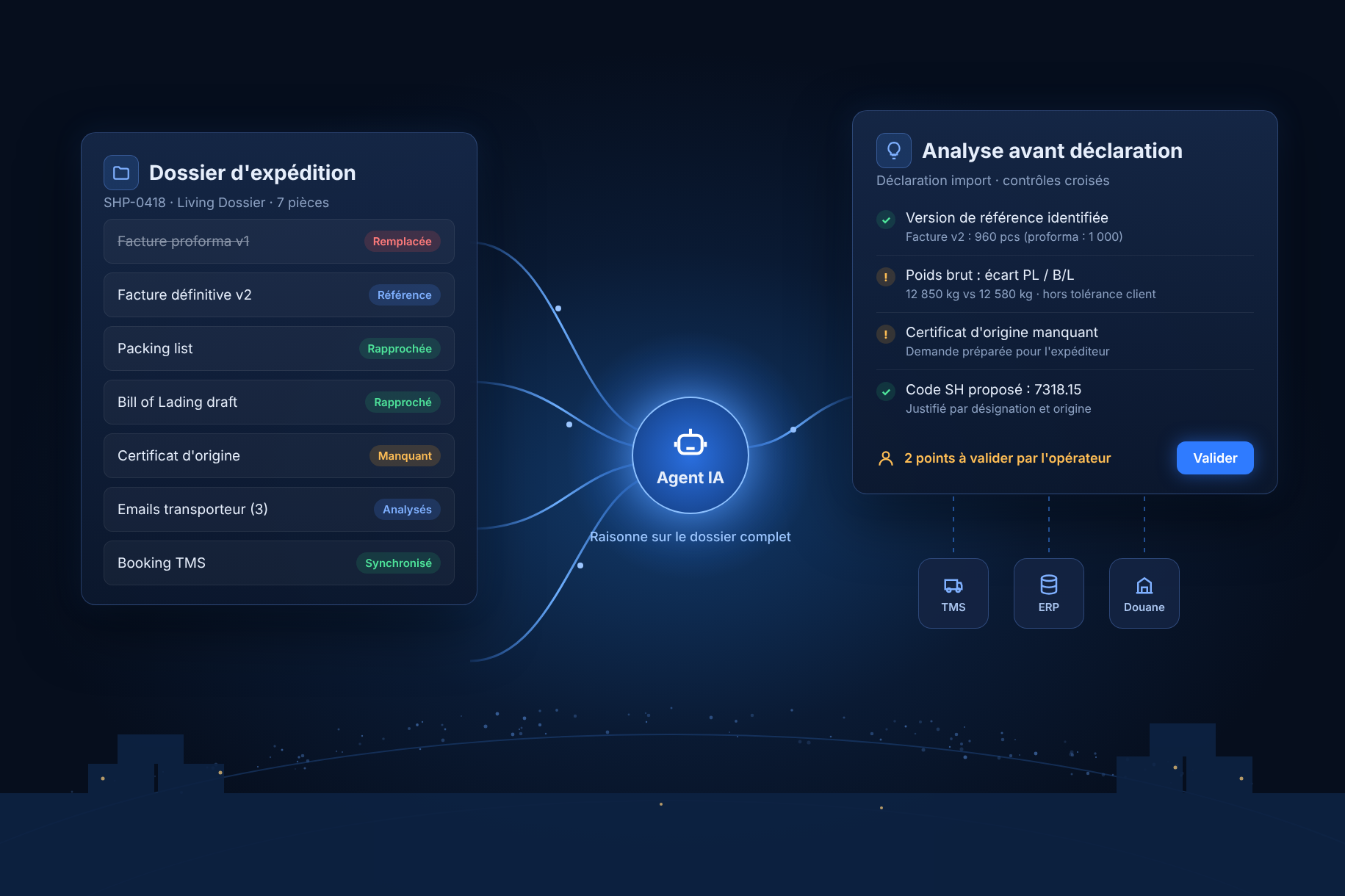
An AI logistics agent must analyze the entire file because no single shipping document, taken in isolation, contains the full picture of a transaction. The invoice shows what was sold, the packing list what was packed, the bill of lading what was shipped, and the emails what has changed in the meantime. An agent who reads these documents one by one may extract each piece of data correctly and still make the wrong decision. An agent who analyzes the entire file as a whole spots discrepancies, understands the changes, and knows when to stop and seek an operator’s advice.
AI agents are making their way into logistics with a bold promise: to read, decide, and act on behalf of teams. In transportation and customs, this promise can only be fulfilled if the agent has the right context. And that context is the case file.
An AI agent is a system capable of pursuing a goal in several steps: it observes, plans, uses tools (reading documents, running queries in a TMS, sending an email), and adjusts its actions based on the results. This is what distinguishes it from a conversational assistant, which answers a question, or a data extraction tool, which converts a document into data.
In logistics, the term encompasses a wide range of functions: demand forecasting, route optimization, warehouse management, and customer service. This article focuses on agents who handle documentation-related operations: opening a shipment file, entering data into the TMS, preparing a customs declaration, and verifying documents submitted in connection with a letter of credit. This is where the issue of a complete file arises.
An international shipment often involves about ten documents: purchase order, pro forma invoice, final invoice, packing list, booking confirmation, shipping instructions, draft and original bills of lading, certificate of origin, customs declaration, and freight invoices. Each document addresses a different issue and is often issued by a different party (exporter, carrier, freight forwarder, customs). Our article on detecting inconsistencies between invoices, packing lists, and bills of lading explains how these documents relate to one another and why they do not necessarily have to be identical.
A file is not set in stone. The quantity changes after a stockout, the vessel changes after a booking reschedule, and the recipient changes at the customer’s request. The most recent document is not always the correct one, and the change is sometimes only noted in an email. An agent who can only view one document at a time cannot know which version is the authoritative one.
OCR reads the data, while IDP extracts and structures it (see the difference between IDP and OCR). However, data can be extracted perfectly yet still be inconsistent with the rest of the file. The gross weight read from the packing list is exact down to the character. It is simply different from the weight on the bill of lading. Only cross-checking reveals this discrepancy.
The agent reads a gross weight of 12,850 kg on the packing list and enters it into the TMS. The bill of lading shows 12,580 kg (gross weight). If this discrepancy is not flagged, an unverified value is now in the system, then in the declaration, and finally in the freight invoice. This is the mechanism described in our article on data entry errors in logistics operations: automating data entry without verification is the same as automating the propagation of errors.
The pro forma invoice listed 1,000 units. The final invoice, which arrived two days later, listed 960. If the agent opened the file based on the pro forma invoice and is unaware that a new version exists, he or she will prepare an incorrect declaration with complete confidence.
On a bill of lading, the notify party is often the buyer, the buyer’s freight forwarder, or the buyer’s customs broker at the destination. An agent unfamiliar with the shipment may mistake this party for the consignee and send the documents or the notice of arrival to the wrong entity.
One customer requires a specific carrier, another enforces a zero-tolerance policy on weights, and a third requires specific documents for a particular destination. These rules are not listed on any of the shipping documents. They are part of the context of the case, and an agent who is unaware of them may suggest actions that do not comply with the requirements.
An agent who bases a decision on a single document cannot justify that decision by referring to other documents. When the customs officer or auditor asks, “Why this HS code?” or “Why this weight?”, there is no documentary evidence to present. However, in customs, the responsibility for the accuracy of the data remains with the declarant.
A complete file is more than just a stack of PDFs. For an agent to make informed decisions, they must have access to six layers of information:
To this end, Docloop creates a comprehensive overview of the file, which is updated every time a new document is received or a document is approved, providing all teams with a consistent view of the operation. The concept is detailed in our article “Document-Centric Agentic AI: Definition.”
Let's take the same request: "Prepare the import declaration for this shipment."
The agent, who reviews each document individually, opens the invoice, extracts the description, value, and country of origin, and then suggests an HS code. He adds the weight from the packing list. The declaration is ready in a matter of seconds. It is based on a pro forma invoice that has since been replaced, a weight different from that on the B/L, and a certificate of origin that was never received.
The agent reviewing the file begins by verifying that it is complete: if the certificate of origin required for the requested tariff preference is missing, the agent notes this. The agent identifies the final invoice as the reference version. The agent compares the weight on the packing list with that on the B/L, notes a discrepancy exceeding the client’s tolerance, and submits it to the operator, along with both supporting documents. He proposes an HS code, citing the description and characteristics of the goods (material, composition, function) that justify it. The declaration takes a few more minutes to complete. It is much less likely to be rejected or flagged for review due to inconsistencies in the documentation.
The mechanism that enables an agent to analyze a case is document reconciliation: automatically cross-referencing data from multiple documents and sources to verify their consistency. It is based on four capabilities:
This reconciliation is not a one-time check. It is repeated for each new document, which allows us to shift from a focus on verification to a focus on ensuring document reliability. For customs, this is the role of Docloop’s Customs Compliance Engine.
Large language models can read a document and summarize its content. However, they are not sufficient on their own to manage a logistics operation:
This is the difference between a general-purpose assistant and a specialized domain agent, as explained in our comparison of IDP versus AI-powered document agents.
Analyzing the entire file does not mean automating everything. On the contrary, it helps determine when human intervention is necessary. An agent familiar with the file can handle low-risk tasks (attaching a document, entering a reference number) without intervention and refer to the operator any discrepancies that exceed tolerances, missing documents, and decisions with customs or contractual implications.
This is the principle of graduated human supervision: the agent’s level of autonomy depends on the risk associated with the action. Entering a booking reference does not require the same validation as filing a customs declaration. Any binding action, such as filing a declaration, must still be validated by the declarant. The operator remains in control: he or she sets the level of autonomy and resolves exceptions.
Before choosing a solution, these questions help determine whether the agent is truly thinking through the case:
A vague answer to the first question is usually enough to identify an extraction tool that is presented as an agent.