FAQs
No items found.

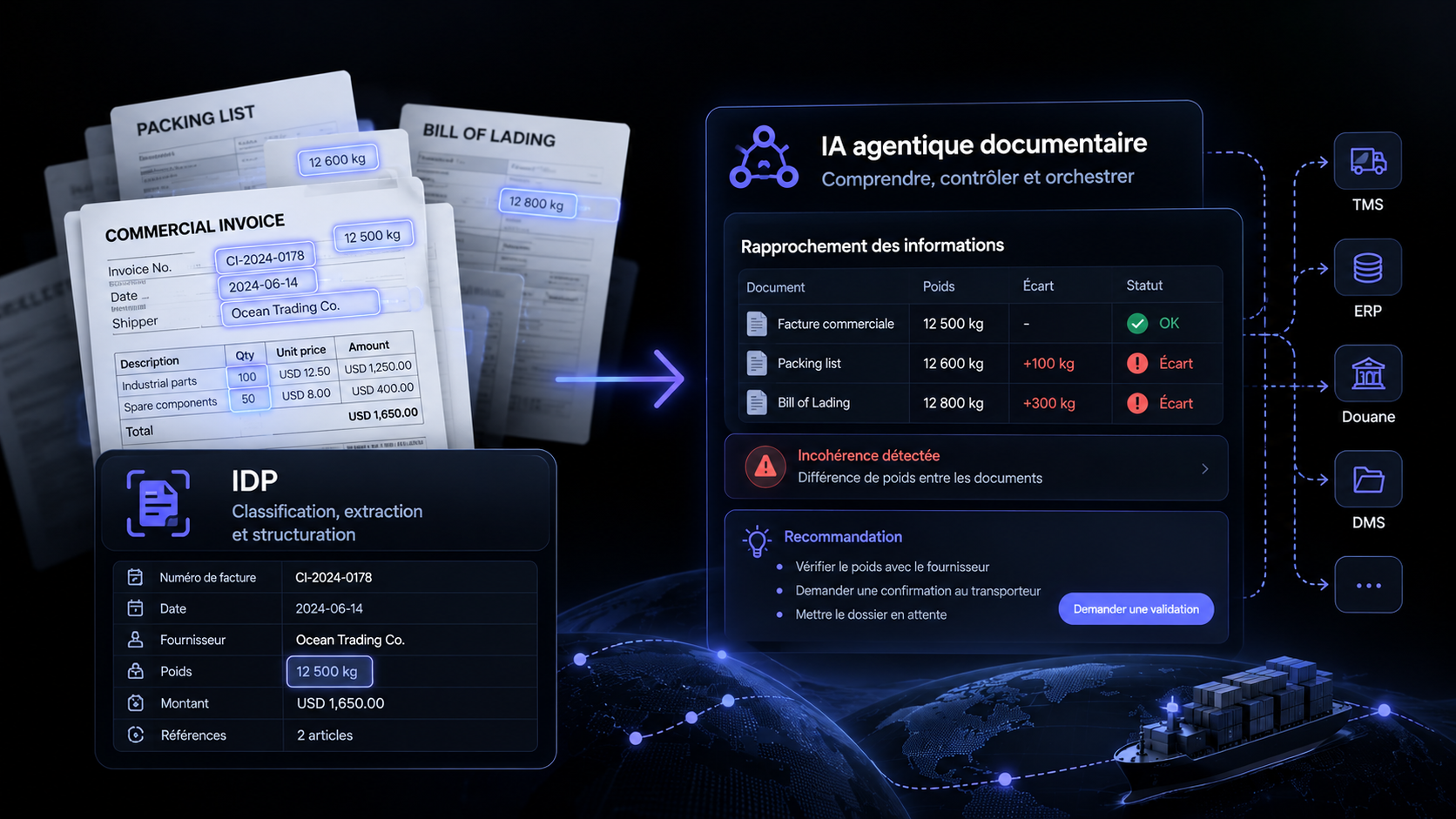
A commercial invoice, a packing list, and a bill of lading contain hundreds of pieces of information that are useful for logistics operations. Intelligent Document Processing (IDP) technology identifies these documents and extracts quantities, weights, part numbers, amounts, and document numbers.
But what happens when the weight listed on the invoice does not match the weight on the bill of lading? The issue is no longer simply a matter of reading or extracting information. You have to compare multiple documents, identify the discrepancy, understand its context, determine whether it is significant, and, if necessary, initiate an audit.
This is where the difference between IDP and agent-based documentary AI becomes particularly significant.
IDP enables the conversion of documents into structured data. Document-based AI goes a step further: it uses this data in context, applies business rules, cross-references multiple sources, identifies anomalies, and orchestrates the next steps in the process.
In logistics and international trade, this distinction is essential because a transaction rarely relies on a single document.
Intelligent Document Processing, or IDP, refers to technologies that automate document processing in order to extract structured and actionable information from them.
Here's how it works:
Document → classification → extraction → structuring → validation
A commercial invoice is converted into structured data:
The same principle applies to a packing list, a bill of lading, a CMR, a shipping order, or a customs document.
The main benefit of IDP is that it eliminates some of the manual work involved in reading and entering document data. The extracted data is fed into various systems:
IDP enables the conversion of unstructured documents into information that can be directly used by the company's systems. But this automation primarily answers one question:
What is in this document?
However, in logistics operations, this question is not always sufficient.
Let's take three documents from the same shipment:
The IDP correctly extracts the information from each document. However, if the total gross weight on the packing list is 12,500 kg and that on the bill of lading is 12,800 kg for the same shipment, the extraction may be perfectly correct while still leaving a discrepancy that needs to be analyzed.
The information was interpreted correctly. It simply hasn't yet been compared with other available information.
It is this difference between extracting data and ensuring the reliability of that data in its context that paves the way for a more agent-based approach. The Docloop documentation specifically distinguishes document extraction from reconciliation, consolidation, and compliance checking.
Document-based agent AI does more than just extract information from a document. It uses the available information to analyze a document-based situation, perform several processing steps, apply business rules, and determine the actions to be taken.
Extract → compare → verify → interpret → recommend → act
The goal, therefore, is no longer simply to convert a document into data. It is to enable the system to understand what that data means in the context of a transaction.
Let's take another look at an invoice, a packing list, and a bill of lading. A document-based agent-oriented approach can:
The goal is not to let AI make all decisions on its own. In critical document management processes, human oversight, business rules, and auditability remain essential.
The fundamental difference lies in what the system is asked to do with the documents.
This distinction does not mean that agent-based documentary AI replaces the IDP. On the contrary, data extraction and structuring can form an essential foundation for the agent-based process. The challenge is to move from automating a single documentary task to automating a more comprehensive documentary process.
In international trade, a transaction rarely involves just one document. A consolidated shipment includes:
The same information can be re-entered or used in multiple systems: ERP, TMS, customs tools, customer platforms, or banking tools. The problem then arises in the relationships between the documents.
A quantity may differ between the invoice and the packing list. A gross weight may differ between the packing list and the bill of lading. An HS code may be inconsistent with the description of the goods. A freight invoice may not match the negotiated rate.
An essential document may be missing prior to customs clearance. In such situations, no single document on its own necessarily provides a clear understanding of the problem.
We need to analyze several sources at the same time.
That is why the value of documentary AI is no longer limited to the quality of the information it extracts. It also depends on its ability to understand the relationships between the available information.
This is where document reconciliation. It involves automatically matching, comparing, and verifying information from multiple documents or sources to identify inconsistencies.
The difference between the main building blocks can be summarized as follows:
OCR: Reads the document.
IDP: extracts and structures the data.
Data reconciliation: compares data across multiple sources.
Agent-based documentary AI: uses this information and context to analyze, recommend, and orchestrate the next steps.
Reconciliation makes it possible to detect:
It becomes an essential component when multiple documents describe the same operation.
It would be an oversimplification to frame the issue as a choice between IDP and agent-based AI. In many processes, the two approaches are complementary. The architecture can be represented as follows:
Documents
↓
OCR / Document Comprehension
↓
IDP
↓
Structured Data
↓
Documentary Context
↓
Reconciliation
↓
Agent-Based Documentary AI
↓
Review / Recommendation / Action
↓
Human validation, if necessary
↓
Business System
IDP provides the ability to quickly convert documents into actionable data. The agent layer uses this data to make decisions at various stages of the process. This complementary approach preserves the benefits of document automation while adding more context, control, and orchestration.
Let's consider an international transaction involving a commercial invoice, a packing list, and a bill of lading.
The various documents are received via email, the portal, or other document delivery channels.
The IDP identifies the documents and extracts the necessary data:
The system compares the data extracted from the various documents. For example, it detects a discrepancy in gross weight between the packing list and the bill of lading.
The document-based agent approach identifies the relevant data, locates the documents causing the discrepancy, and applies the control rules defined for the process.
Depending on the context, the system can:
The goal is not simply to flag that a data point is different, but to provide teams with the information they need to address the anomaly.
The two approaches address different levels of complexity.
The goal is not to systematically replace one technology with another. The goal is to determine to what extent the document management process should be automated.
Evolution is actually quite simple to understand.
The system no longer processes just a single document. It uses information from multiple documents related to the same transaction.
The extracted data is no longer considered an end in itself. It is compared with other information to verify its consistency.
Identifying a difference is only the first step. The challenge is also to understand that difference and determine the next steps in the process.
Document-based agent AI performs a series of operations: analyzing, verifying, searching for information, applying a rule, issuing an alert, or requesting validation. It is this transition that gradually transforms document automation into business-oriented document reasoning.