FAQs
No items found.

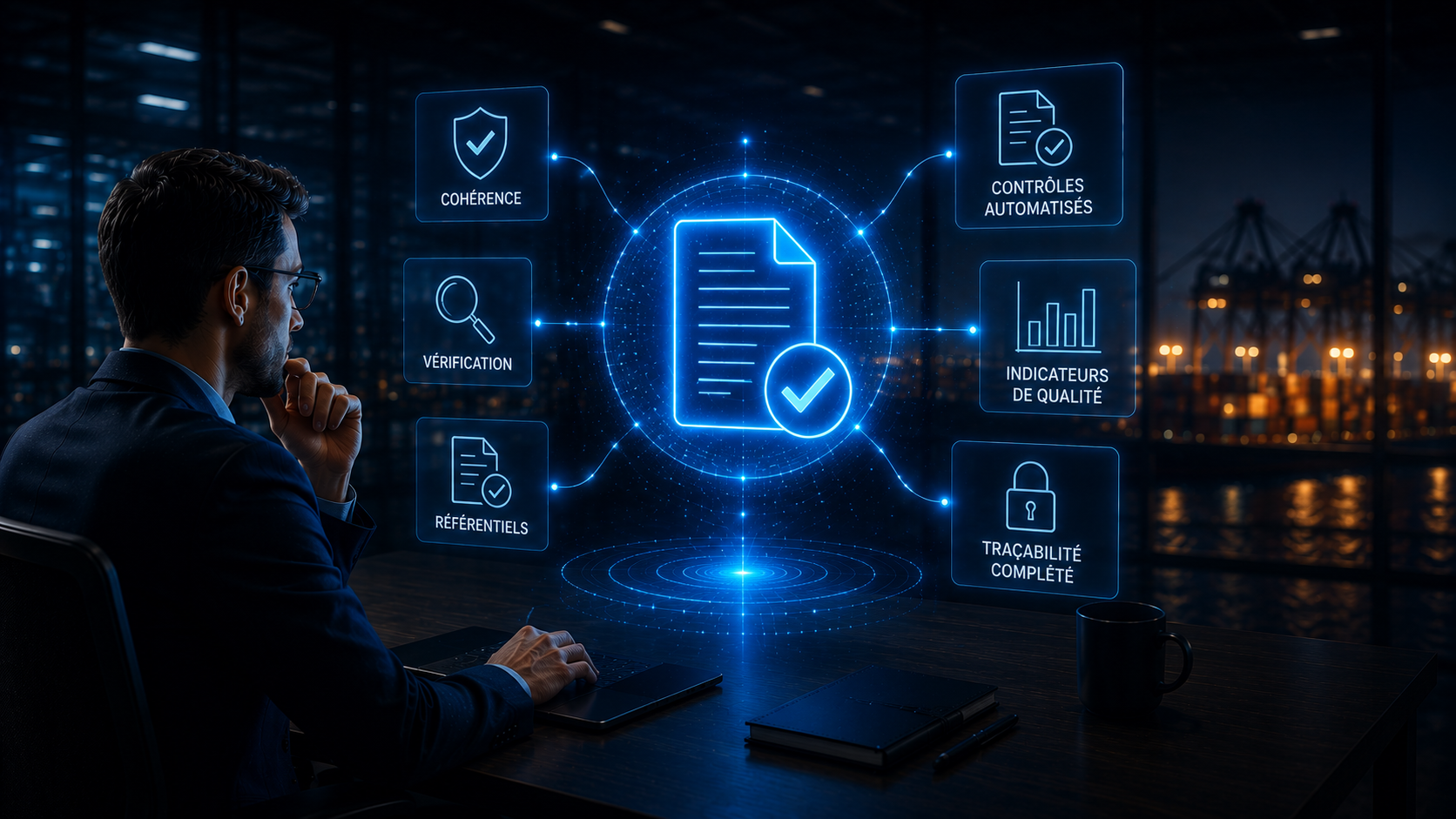
International trade still relies heavily on the exchange of documents. Commercial invoices, packing lists, bills of lading, certificates of origin, customs declarations, proofs of delivery, and banking documents are exchanged daily among shippers, freight forwarders, carriers, customs brokers, banks, and government agencies.
Despite advances in digitization, a large portion of these workflows continues to be managed through:
In this context, the real challenge is no longer simply to extract data from a document. It is now essential to ensure that the information in the document is:
That is precisely the goal of document reliability assurance.
Document reliability refers to the set of mechanisms used to transform scattered documents into verified, consistent, and directly usable document data within business processes. Today, it is one of the cornerstones of Trade Document Intelligence.
An international transaction rarely involves a single document. Each transaction generally generates several supporting documents:
This complexity in document management comes with significant operational costs. In many organizations, document management is still largely done manually. Teams often spend between 35 and 50 minutes processing a single file, while data entry errors still account for 3 to 8% of the data processed. In some international shipping flows, between 12 and 20% of shipments may also be delayed or held up due to document anomalies or non-compliance.
Beyond delays, these inefficiencies generate hidden costs throughout the supply chain: manual rework, additional checks, penalties, disputes, and unnecessary mobilization of operational teams.
The same information is often re-entered into multiple tools:
Each time data is re-entered, the risk of error automatically increases.
Critical information is scattered across several documents. It is becoming difficult to get a consolidated view of the operation.
Despite digitization efforts, email remains one of the primary channels for exchanging documents in international trade. This situation makes it difficult to track, monitor, and trace files.
A simple inconsistency between two documents can result in:
The problem, then, is not a lack of information but the reliability of the available information.
Companies already have access to a wide range of document management technologies. Yet document quality remains a major concern. The reason is simple: simply reading or storing a document does not guarantee its reliability.
OCR is used to extract data, while EDM is used to organize and archive documents. Document reliability addresses a different issue:
Can we trust the information contained in the documentation?
This is a question that traditional tools rarely address.
Document reliability involves ensuring the quality of document data before it is used in operational processes.
It is not limited to extraction. It combines several complementary capabilities:
The goal is not to produce more data, but to produce reliable documentary data.
In the Docloop approach, document reliability is one of the pillars of Trade Document Intelligence.
It enables a shift from a document-processing approach to a document-based reasoning approach.
The first step is to identify and extract the information contained in the documents.
This capability is now widely supported by modern document processing solutions.
However, data extraction alone does not guarantee data quality.
Document reconciliation involves automatically matching the information contained in multiple documents.
The goal is to identify inconsistencies before they become operational problems.
The extracted information is consolidated to build a coherent picture of the operation. This consolidation allows us to move beyond a document-by-document analysis.
The data is compared against business, regulatory, or contractual standards to identify potential discrepancies.
The system can assist teams by highlighting:
The goal is not to replace the expert but to allow him or her to focus on the truly complex cases.
Most documentary errors do not appear within a single document. They appear across multiple documents. Let’s look at a few examples:
These discrepancies are often difficult to detect manually. However, they can be quite costly:
Document reconciliation makes it possible to automate these consistency checks. It is now one of the most important mechanisms for ensuring document reliability. It is not limited to comparing two documents; rather, it relies on several complementary levels of verification.
Cross-Document Reconciliation
It involves automatically comparing the information contained in various documents in the file.
Examples:
Operational Reconciliation
The documents are compared with the actual events of the operation.
Examples:
Regulatory Reconciliation
The documentary information is compared with the applicable standards and regulatory requirements.
Examples:
Reconciliation with internal data sources
The documentary data is reconciled with the company's reference data:
Expert Reconciliation
The validations and corrections made by the business teams gradually enhance the control mechanisms and enable continuous improvement in document quality.
This multi-level approach explains why document reconciliation is now one of the cornerstones of document reliability and Trade Document Intelligence.
A documentary file is never static. New documents are added. Validations are performed. Information is corrected. Operational events occur.
The Living Dossier provides a continuously updated view of the project. Each document enriches the dossier. Each check improves its reliability. Each reconciliation performed strengthens its consistency.
The Living Dossier thus becomes the central tool for ensuring the reliability of documents. It also makes it possible to preserve:
This capability is becoming essential in environments subject to increasing auditability requirements.
Regulatory compliance depends directly on the quality of documentation. Government agencies and regulatory bodies require information:
The key issues include, in particular:
Incorrect or inconsistent information can lead to:
Document reliability thus contributes directly to managing regulatory risk.
International trade is generating an ever-increasing volume of documents. Yet companies are seeking to reduce administrative tasks without increasing their exposure to risk. The solution does not lie in accumulating more documents. It lies in the ability to generate reliable document data as soon as the documents are received.
Document reliability represents a significant shift from traditional document management approaches. The goal is no longer simply to read or store documents. It is to transform scattered documents into coherent, verified information that can be immediately utilized by operations.
This transition marks the shift from documents to reliable data. It is also what makes document reliability one of the pillars of Trade Document Intelligence and a true System of Document Intelligence for international trade.