FAQs
No items found.

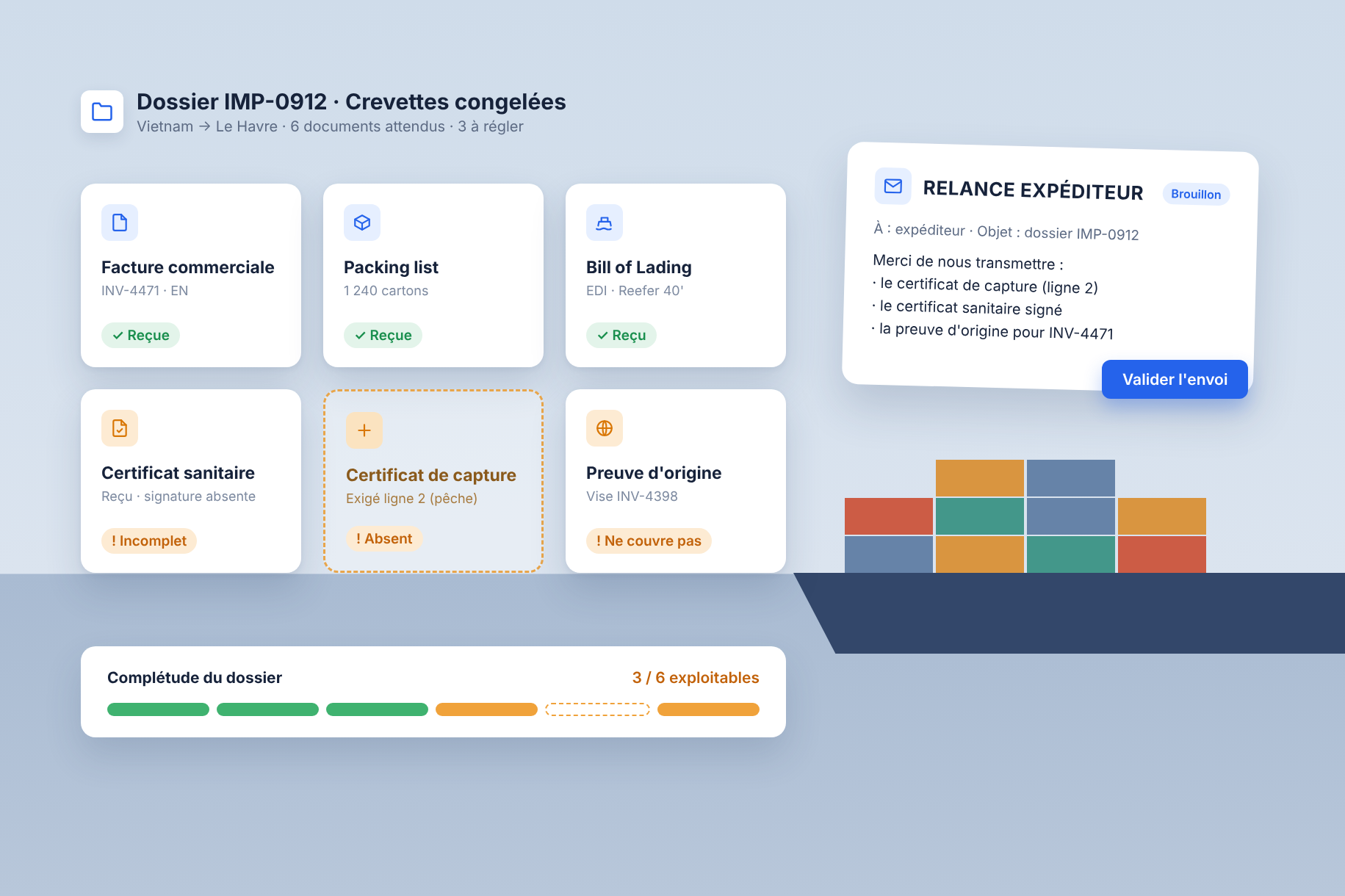
To identify missing documents before customs clearance, you must first determine the list of documents required for the transaction (based on the goods, their code, origin, customs procedure, and mode of transport), then compare it with the documents actually received, verifying that each one is valid and properly covers the goods. A fixed checklist is not enough: the list varies from one case to another, and a document that appears to be “present” may be unusable. The best time to do this is upon receipt of the first document, not the day before filing; this allows time to follow up with the sender.
An incomplete shipment is often not discovered until the time of customs declaration, when the goods have already arrived. This means having to follow up with a supplier on the other side of the world, wait, and pay for the goods to be held in storage. Here’s how to avoid this, using a method that can be done manually or automated.
The declarant must have the documents supporting the declaration in their possession at the time of filing and must make them available to customs (Article 163 of the Union Customs Code, or UCC).The declarant is responsible for the accuracy and completeness of the declaration andfor the authenticity of these documents (Article 15). A missing document therefore has direct consequences:
The European Access2Markets portal distinguishes between general documents and specific documents. In practice, an import dossier consists of four categories:
The foundation is solid. Everything else is subject to change, and that's where the documentation is lacking.
The required documents depend on a combination of factors:
A single shipment may thus include three different goods, each requiring its own set of documents. A single checklist may omit some or incorrectly require others. This is why tariff classification errors—discussed in our article “How Can AI Assist with HS Code Classification?”—also have documentation implications: an incorrect code results in an incorrect list of required documents.
The most common pitfall isn't a missing document; it's a document that has been received but is unusable. There are four types of "missing" documents:
The last two discrepancies can only be identified by comparing the documents with one another: this is the principle of document reconciliation. Discrepancies in content between the invoice, packing list, and shipping document are detailed in our article on detecting inconsistencies between the invoice, packing list, and bill of lading.
Invoice by email, packing list via the portal, bill of lading via EDI, certificate by mail a week later: a file is compiled over several days, often in multiple languages. Without an updated file status upon each arrival, no one knows what’s missing until they open the file to file the declaration.
Let’s consider a typical case. A French importer receives a container of frozen shrimp from Vietnam, consisting of two types: farmed shrimp and wild shrimp. The importer requests the preferential treatment provided for under the free trade agreement between the European Union and Vietnam.
Step 1: Determine what is required. The invoice, packing list, and bill of lading form the foundation. Products of animal origin must pass through a border control point with an official health certificate and a Common Health Entry Document (DSCE), which the importer or their representative must complete in TRACES. Wild-caught shrimp require an additional catch certificate to combat illegal fishing; farmed shrimp do not. Finally, to qualify for preferential treatment, proof of origin in accordance with the agreement is required.
Step 2: Compare the documents with the items received. The file, compiled as the sender’s shipments arrived, contains:
On a generic checklist, this file would have appeared almost complete: five out of six documents received. In reality, three documents pose a problem: two prevent importation (health and catch certificates), and the third results in the loss of preferential treatment.
What this example shows:
This is the type of inventory that Docloop compiles when a file is opened, as shown in a demonstration reported by *Profession Logistique* (No. 11, Fall 2026): documents received, missing documents, and the reason each document is required, along with a confidence rating for each reading.
Arrival notice, booking, pro forma invoice: the first document is sufficient to create the file and identify the transaction (goods, origin, transportation). Waiting until everything has arrived means discovering shortages too late. This principle is discussed in our article “Why Must a Logistics AI Agent Analyze a Complete File?”
Based on the goods and their code, origin, trade regime, and mode of transport, compile a list of the documents required by regulations (TARIC measures, proofs of origin, authorizations). Then add internal business rules: customer requirements and company procedures. These are the two categories of rules that Docloop distinguishes in its reconciliation module: external rules, derived from regulations, and internal rules, specific to each company.
Identify the type of each document (invoice, packing list, bill of lading, certificate, DAE) and link it to the correct transaction, regardless of its channel or language. A multilingual system must focus on meaning: a “certificado de origen” is a certificate of origin. The difference between OCR and document-based AI in this regard is explained in “OCR or Document-Based AI: What Are the Differences for Logistics?”
For each document expected and received: Is it complete, signed, and valid? Does its reference number match the invoice? Does it cover all the relevant line items and quantities? This is the step that turns a simple list of checked boxes into a real verification process.
A helpful follow-up message specifies which document is missing, why it is required, and for which lines on the invoice. It is sent to the sender or the customer as soon as the missing document is identified, not when it is reported. Eventually, Docloop envisions that an agent will draft the email to the partner themselves, with the human still retaining the decision to send it.
Keep a record of what was expected, received, followed up on, and approved. Documents must be retained for at least three years (Article 51 of the UCC), and a retrospective audit may request any of them. For an Authorized Economic Operator (AEO), this record supports self-auditing, which Docloop estimates accounts for about 2 to 3% of declarations: reviewing submitted files helps identify recurring deficiencies by supplier or by supply chain.
The tool does not replace the expert; it generates alerts. AI may overlook a piece of context that is obvious to a human—such as an approved exception or a document sent through another channel. Each alert must therefore be explained so that the reporter can dismiss or confirm it within a few seconds. This principle of graduated human oversight is detailed in our article “Document-centric agentic AI: Definition.”
Identifying missing documents is one of the building blocks of a broader approach, described in our article “How to Automate Customs Document Verification,” and one of the checks performed by Docloop’s Customs Compliance Engine. For the French context, see also the changes introduced by DELTA I/E.