FAQs
No items found.

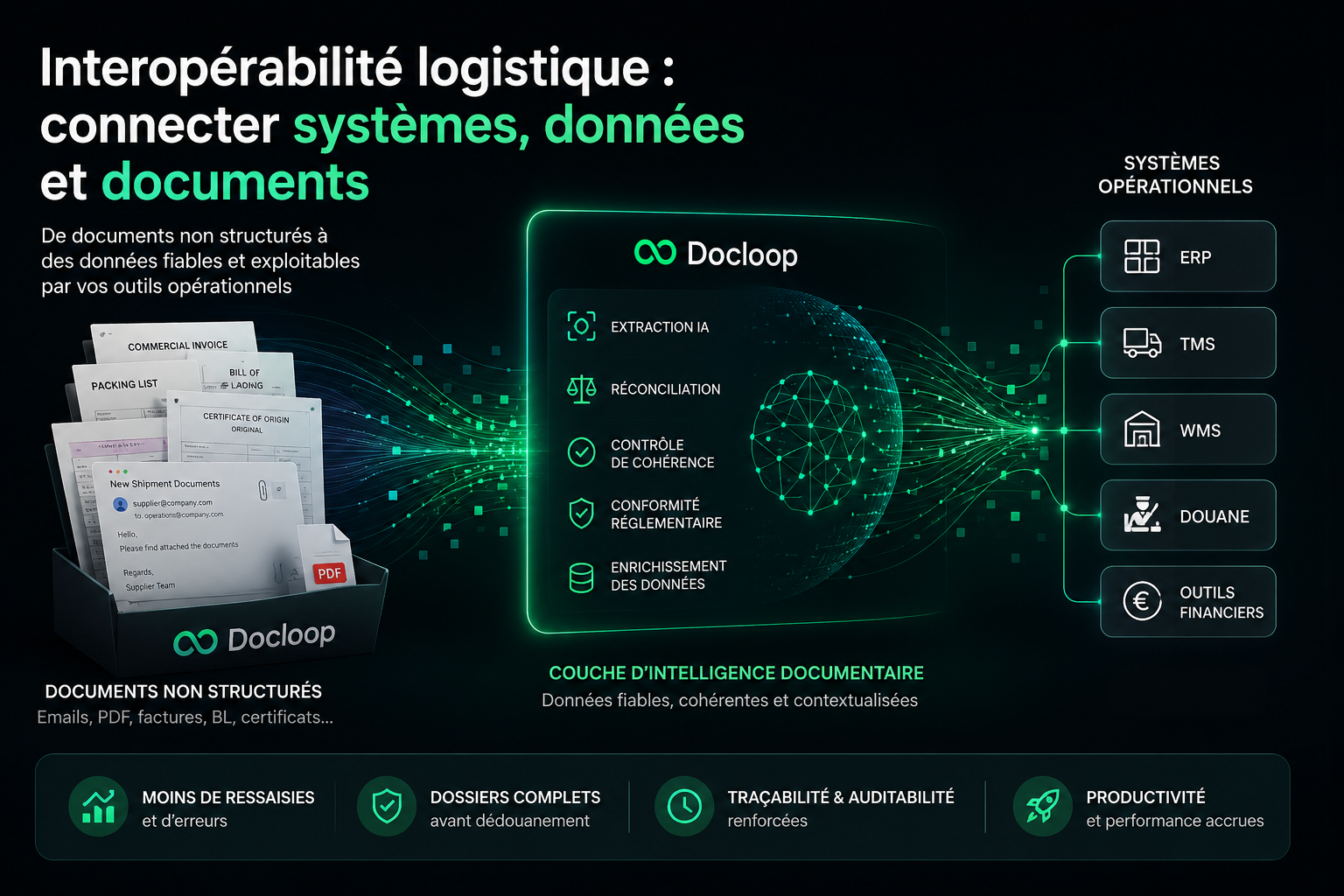
Logistics is now largely digitized. ERP, TMS, WMS, customs software, customer platforms, carrier portals, and financial tools exchange vast amounts of data on a daily basis.
Yet, in many companies, teams continue to search for information in their emails, open PDFs, manually compare multiple documents, and re-enter the same data into different systems.
The issue, therefore, is no longer simply about connecting applications. It is about ensuring that information flows without the need for re-entry, without loss of context, and without the propagation of errors.
That is the whole point oflogistics interoperability.
But there remains a significant limitation in the way this is generally approached. An API can connect two systems. EDI can automate the transmission of structured information. A standard can enable multiple applications to speak a common language.
However, this does not guarantee that the data exchanged is accurate, complete, and consistent with the transaction as a whole.
However, in the fields of transportation, logistics, customs, and international trade, much of the critical information is still contained in documents: commercial invoices, packing lists, bills of lading, CMRs, certificates of origin, customs declarations, freight invoices, and proofs of delivery.
True logistics interoperability, therefore, is no longer just about enabling systems to communicate with one another. It also involves transforming scattered documents into reliable, reconciled data that can be directly utilized by these systems.
Logistics interoperability refers to the ability of different systems, companies, and supply chain participants to automatically exchange, understand, and utilize shared data throughout a logistics operation.
An international shipment may involve many different parties:
Each system uses its own tools and generates its own data. As a result, a single transaction can pass through an ERP, a TMS, a WMS, a customs platform, and several external portals.
Interoperability is designed to ensure that moving from one system to another does not require re-entry or manual intervention.
However, it is important to distinguish between different levels of interoperability.
Technical interoperability allows systems to communicate using APIs, connectors, or exchange protocols.
Semantic interoperability ensures that different systems assign the same meaning to the information they exchange.
Document interoperability makes it possible to leverage the information contained in heterogeneous and unstructured documents.
Finally, operational interoperability involves transforming this information into data that is reliable enough to support business processes.
This distinction is essential. Because two systems that are perfectly connected can still exchange incorrect information.
A logistics operation almost never relies on a single system or document.
Let's take the example of an international shipment. It can result in:
Each document contains a portion of the information. None of them, on its own, provides a complete picture of the transaction.
At the same time, this information must be fed into various systems: ERP, TMS, WMS, customs software, customer platforms, and financial tools.
This fragmentation creates numerous difficulties. The same reference number may be entered multiple times. A weight may differ between two documents. A quantity may be changed without all systems being updated. A regulatory document may be missing at the time of customs clearance. A freight invoice may not match the negotiated terms.
International trade still relies heavily on emails, PDFs, disparate documents, manual data entry, and scattered validation processes. The real challenge, therefore, is no longer simply to extract data, but to ensure its reliability, consistency, completeness, and operational usability.
In this context, connecting applications is essential. But that only solves part of the problem.
EDI, APIs, and exchange standards have significantly improved the flow of information throughout the supply chain.
In particular, they enable the automatic transmission of:
But these technologies essentially answer one key question:
How do you transfer information from one system to another?
They do not necessarily answer three other fundamental questions:
Is this information correct?
Is it consistent with the rest of the file?
Can it be used automatically without recreating a manual check?
Let's imagine that a single transaction involves three documents:
All three pieces of information can be transmitted via API without any issues. The systems are technically connected.
However, the operational problem remains: Which data is reliable?
Technical interoperability allows data to flow. It does not guarantee the data's consistency.
And when incorrect data is automatically propagated across multiple systems, automation can amplify the error instead of resolving it.
Much of the supply chain still relies on unstructured data.
Orders are received via email. Invoices are sent as PDF files. Carriers provide CMRs or proof of delivery. International shipments generate packing lists, bills of lading, certificates, and customs documents.
These documents contain the data needed for operations. But as long as this information remains locked away in PDFs, email attachments, or scattered files, it is not truly interoperable.
This is one of the main blind spots in logistics interoperability.
An ERP system can be connected to a TMS. A TMS can be connected to customs software. But if an operator still has to manually open an invoice received by email, identify a part number, compare a quantity with a packing list, and then enter that information into the TMS, the chain is only partially interoperable.
The document-based AI solution Docloop is designed to bridge this gap between documents and systems. It extracts information from unstructured documents and emails, reconciles data from multiple sources, and feeds operational systems such as TMS, WMS, ERP, and customs tools.
A supply chain is therefore not truly interoperable as long as its documents remain isolated from its operational systems.
Logistics interoperability can be viewed as a five-level progression:
This development is fundamentally changing the way we approach interoperability.
It is no longer just a matter of moving data from point A to point B. We must be able to verify it, place it in the context of a given operation, and compare it with other available sources.
That is precisely the role of document reconciliation.
OCR reads a document. Intelligent Document Processing extracts data from it. Document reconciliation answers an additional question:
Is the information contained throughout the file consistent, complete, and usable?
In particular, this approach makes it possible to detect:
Document reconciliation involves automatically cross-referencing, verifying, and comparing information from multiple sources to detect anomalies before they result in costs, delays, or regulatory risks.
Documentary AI creates an intermediate layer between documents and operational systems.
Its role isn't limited to simply reading a PDF or extracting a few fields. It can be involved in the entire information lifecycle.
Documents may come from:
The goal is to gather the information needed for an operation without relying on a single format or channel.
The information contained in invoices, shipping documents, certificates, or forms is identified and organized.
This step makes it possible to extract and use information that was previously locked away in unstructured documents.
But extraction is only the starting point.
Data is reconciled across multiple documents.
Quantities, weights, values, product codes, countries of origin, or other critical information can be compared to identify any discrepancies.
This capability prevents an inconsistency from simply being automatically passed from one system to another.
The validated information is compiled to form a coherent overview of the operation.
The system then stops thinking solely in terms of individual documents. It begins to consider the entire file.
The information can be checked against business rules, internal standards, or regulatory requirements.
In the customs sector, for example, this can help detect:
This approach forms the basis of the Customs Compliance Engine, which is designed to assist teams in preparing and verifying documentation before it is submitted.
Once the data has been extracted, contextualized, and verified, it can be fed into the relevant systems:
The goal is no longer simply to convey information.
The goal is to provide more reliable data, along with its supporting documentation.
Let's consider the case of a freight forwarder who receives four documents via email:
The information contained in these documents must then be entered into the TMS and the customs software.
In a traditional workflow, an operator opens the attachments, searches for relevant information, compares certain fields, and manually re-enters the data into the various tools.
One form of automation involves extracting information and then automatically transmitting it to systems.
But what happens if the quantity listed on the invoice doesn't match the one on the packing list? What if the country of origin differs between two supporting documents? What if a required certificate is missing?
Automation without oversight simply risks spreading the anomaly.
A layer of document intelligence allows us to go a step further.
The documents are scanned. The information they contain is organized and then cross-referenced. Weights, quantities, values, part numbers, and countries of origin can be compared. Discrepancies are detected, and potentially missing items are flagged.
The data can then be verified before being fed into the operational systems.
The challenge, therefore, is no longer simply to automate data flow.
The goal is to avoid automatically propagating errors.
Historically, computer systems have been organized by application.
The ERP manages certain data. The TMS manages other data. The WMS operates in its own context. The customs software handles another part of the process.
But a logistics operator doesn't think solely in terms of systems.
He is thinking through a procedure.
A freight forwarder manages a shipment. A customs broker reviews a customs filing. A compliance officer verifies a set of documents. A finance manager reconciles an invoice with the services rendered and the terms of the contract.
That is why the file becomes a central component of document interoperability.
In the Living Dossier approach, each new document gradually enhances the overall understanding of the operation. New versions may be added. Corrections are made. Validations are performed. Each event changes the status of the dossier.
The system therefore no longer processes each document independently. It maintains a dynamic, context-sensitive representation of the transaction.
The Living Dossier is thus defined as a dynamic, evolving documentary representation of a business process. Each new document enriches the dossier, while checks, reconciliations, and validations progressively enhance its reliability and consistency.
This approach adds an additional dimension to interoperability: persistent context.
Data no longer travels in isolation. It can be linked to its source document, to other information in the file, to the checks performed, and to any human validations.
The more connected systems become, the more critical the quality of the information flowing through them becomes.
An error entered into an isolated system remains localized. An error that is automatically propagated between an ERP, a TMS, a customs tool, and a partner platform can quickly become a much more significant operational problem.
Interoperability must therefore be accompanied by a strategy to ensure the reliability of documents.
This approach goes beyond simply extracting data. It combines several complementary capabilities:
The goal is not to produce more data, but to produce more reliable documentary data that can be directly used in operational processes.
Effective interoperability should bridge the gaps between documents, data, teams, and systems.
Specifically, it can help:
For transportation teams, this means less time spent comparing documents or searching for information.
For customs officials, this makes it possible to identify missing items, discrepancies in quantity, value, or origin, or classification errors at an earlier stage.
For finance teams, reconciling invoices, operational documents, and negotiated terms makes it easier to detect discrepancies.
For businesses, the challenge is also to build a document management infrastructure that is reliable enough to enable greater automation.
Because the goal of interoperability is not simply to enable the flow of more data.
The goal is to circulate data that is reliable enough to be used without having to systematically add a layer of manual verification.
For a long time, logistics interoperability was primarily viewed as an issue of software connectivity.
This step remains essential. APIs, EDI, and standards play a vital role in the flow of information.
But the growing volume of documentation and the proliferation of systems are revealing a new limitation: sharing data does not guarantee its quality, consistency, or reliability.
A supply chain can be fully connected and still rely on manual checks to verify invoices, reconcile packing lists, search for missing documents, or correct inconsistencies between systems.
The next step, therefore, is to bring together three historically separate worlds:
documents, data, and operational systems.
That is precisely the goal of Trade Document Intelligence: to stop treating documents as isolated files and instead view them as components of an operational file that must be understood, reconciled, verified, and utilized.
In this approach, extraction is just one step. Value also comes from the ability to link documents, verify their consistency, detect discrepancies, and produce a more reliable report.
Docloop acts as a layer of document intelligence between documents and operational systems.
The platform enables the conversion of information from emails, PDFs, and logistics documents into structured data, which is then reconciled to identify any inconsistencies.
In particular, it can help:
Docloop's value proposition is based precisely on this ability to link documents to systems while adding a layer of reconciliation and control.
The challenge is not just to get information out faster.
The goal is to make this information more reliable before it is used in operations.