2025: eFTI, the new era of digitalized freight transport in Europe
February 4, 2025
Reading time: 7 minutes
Updated on
March 6, 2026
Freight transport in Europe is undergoing a transformation thanks to eFTI, a European regulation aimed at standardizing and digitizing information exchanges and accelerating the digitization of logistics flows. With key deadlines between 2025 and 2027, this standard promises to reduce administrative costs and improve interoperability between industry players. In this article, updated for 2025, we present the recent changes brought about by eFTI, the stages of its implementation, and its impact on logistics and transport.
What is eFTI and why is it essential in 2025?
Adopted as part of Delegated Regulation (EU) 2024/2024, eFTI is based on European and international standards to harmonize electronic data shared between carriers, customs authorities, and other stakeholders. In 2025, its main objectives are becoming more concrete than ever:
- Standardization of information exchange: a single format for all players in the sector;
- Elimination of paper documents: reduction in human error and improved data security;
- Facilitation of controls: direct and simplified access for authorities via certified platforms.
Key advances and latest developments in eFTI in 2025
Data Harmonization - Current Status as of October 2025
Recent developments in 2025 include the integration of several essential data models:
- European Union Customs Code Data Model (EU CDM), used to structure customs trade.
- European Maritime Single Window (EMSWe) model, facilitating the integration of maritime information.
- Reference model for multimodal transport (UN/CEFACT), supporting the interoperability of logistics flows.
Examples of harmonized elements currently in force:
- eFTI41: gross weight, normalized with units such as GRM (grams), KGM (kilograms).
- eFTI76: country code, based on ISO lists.
- eFTI855: currency code, compliant with UN/CEFACT.
- QR Codes and unique links: enable direct and secure access to information, reducing human error.
- Adoption of data elements with unique technical definitions and formats (format, length, character type).
The adoption of data elements with unique technical definitions and formats (format, length, character type) represents a major step forward for the year 2025.
Standardized Data Structures - Current Implementation
The latest updates for 2025 predict:
- Implementation of data subsets covering: EU legal requirements and specific national regulations.
- Standardization of code lists and business rules.
- Simplification of inspections thanks to data instantly available in the inspectors' language via certified platforms.
Interoperability and reduction of administrative burden by 2025
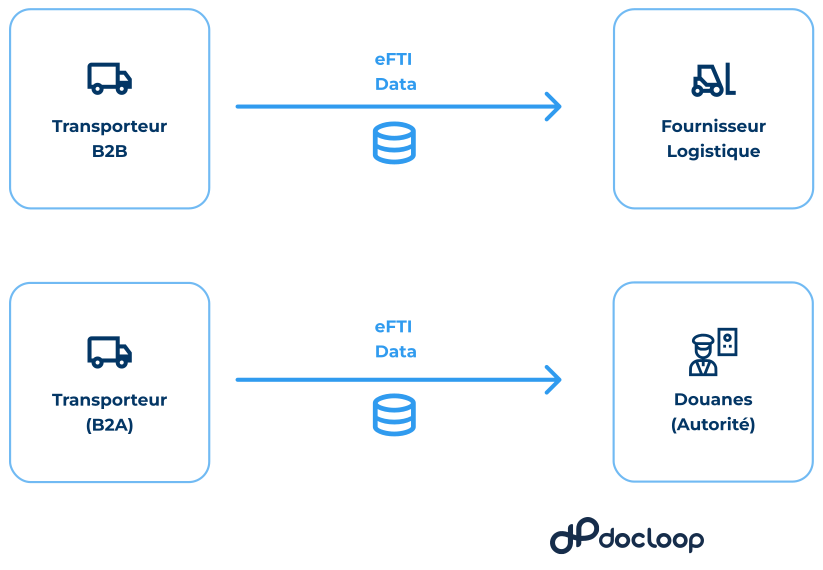
- Economic operators can reuse eFTI data in B2B and B2A exchanges. For example, a B2B exchange could involve sharing standardized information about a shipment between a carrier and a logistics provider via a certified eFTI platform, enabling effective cargo tracking. A B2A exchange could consist of the direct transmission of electronic transport documents to a customs authority for regulatory checks.
- Authorities have simplified access to information to verify compliance.
- Estimated annual reduction in administrative costs of €1 billion for the European transport and logistics sector, according to updated projections for 2025.
What are the advantages for industry players in 2025?
The eFTI offers benefits on several levels, with impacts already measurable at the end of 2025:
- Carriers: reduced waiting times during inspections and fewer administrative errors;
- Authorities: quick access to reliable and standardized information;
- Logistics providers: optimized coordination of operations thanks to centralized data.
Why is this a major step forward for the current sector?
The eFTI will deliver clear and measurable benefits starting in 2025:
- Reduction in administrative costs: up to €1 billion per year for the European sector.
- Interoperability: better coordination between different systems and actors.
- Sustainability: less paper and more efficient processes.
Changes brought about by the eFTI in 2025 and updated schedule
The year 2025 marks the start of the concrete implementation of eFTI. EU Member States are now empowered to develop their IT systems to prepare for paperless freight transport, following the entry into force of the first eFTI implementing and delegated acts in January 2025.
January 2025: Development of IT systems (Phase in progress)
Member States may begin to set up their systems in accordance with the specifications defined by the implementing and delegated acts. These acts specify the design of the systems and the data to be exchanged, establishing the conditions for switching from paper documents to standardized electronic data for all modes of transport. This phase is currently being implemented in several European countries.
September 2025: Adoption of final technical specifications (Recently completed)
The European Commission recently adopted the final technical specifications, providing detailed functional and technical requirements for IT systems and services used by businesses (eFTI platforms and eFTI service providers) as well as rules for their certification.
January 2026: Preparation of certified eFTI platforms (Next step)
eFTI platforms and service providers will be able to start preparing for operations. Member State authorities will be able to start accepting data stored on certified eFTI platforms for inspection.
July 2027: Full application of eFTI regulations
The eFTI regulation will be fully in force. Member State authorities will have to accept information shared electronically by operators via certified eFTI platforms.
Summary of the updated schedule
- January 2025: Development of eFTI-compliant IT systems by EU Member States (ongoing)
- September 2025: Adoption of final technical specifications by the European Commission (completed)
- January 2026: Start of activities on certified eFTI platforms
- July 2027: Full implementation
Key takeaways for 2025 and beyond
The eFTI project represents a major step forward in the digitization and harmonization of document exchanges in freight transport. By 2025, European standards will be reinforced by unified data structures and compliant platforms, reducing administrative costs while increasing the efficiency of controls. This transformation also supports a more sustainable and competitive logistics sector on a global scale, thanks to the digitization of logistics flows.
With full implementation planned for 2027, the transition to fully electronic exchanges marks a decisive step towards paperless transport in the European Union. Companies that begin their transition now in 2025 will be best positioned to take advantage of this digital revolution in freight transport.
FAQs
Q.
What will actually change with eFTI in 2025?
In 2025, transport companies can begin developing and testing their systems in accordance with the new standards. The final technical specifications adopted in September 2025 provide a clear framework for the complete digitization of transport documents.
Q.
Are companies required to adopt eFTI immediately?
No, the legal obligation will not come into effect until July 2027. However, it is recommended that preparations begin in 2025 to ensure a smooth transition and reap the benefits of digitization sooner.
Q.
What are the costs associated with implementing eFTI?
Although initial implementation costs vary depending on the size of the company, the estimated annual savings of €1 billion for the entire European sector more than offset the initial investment.
Q.
How can small businesses prepare?
Small businesses can use shared certified eFTI platforms rather than developing their own systems, thereby significantly reducing entry costs.