FAQs
No items found.

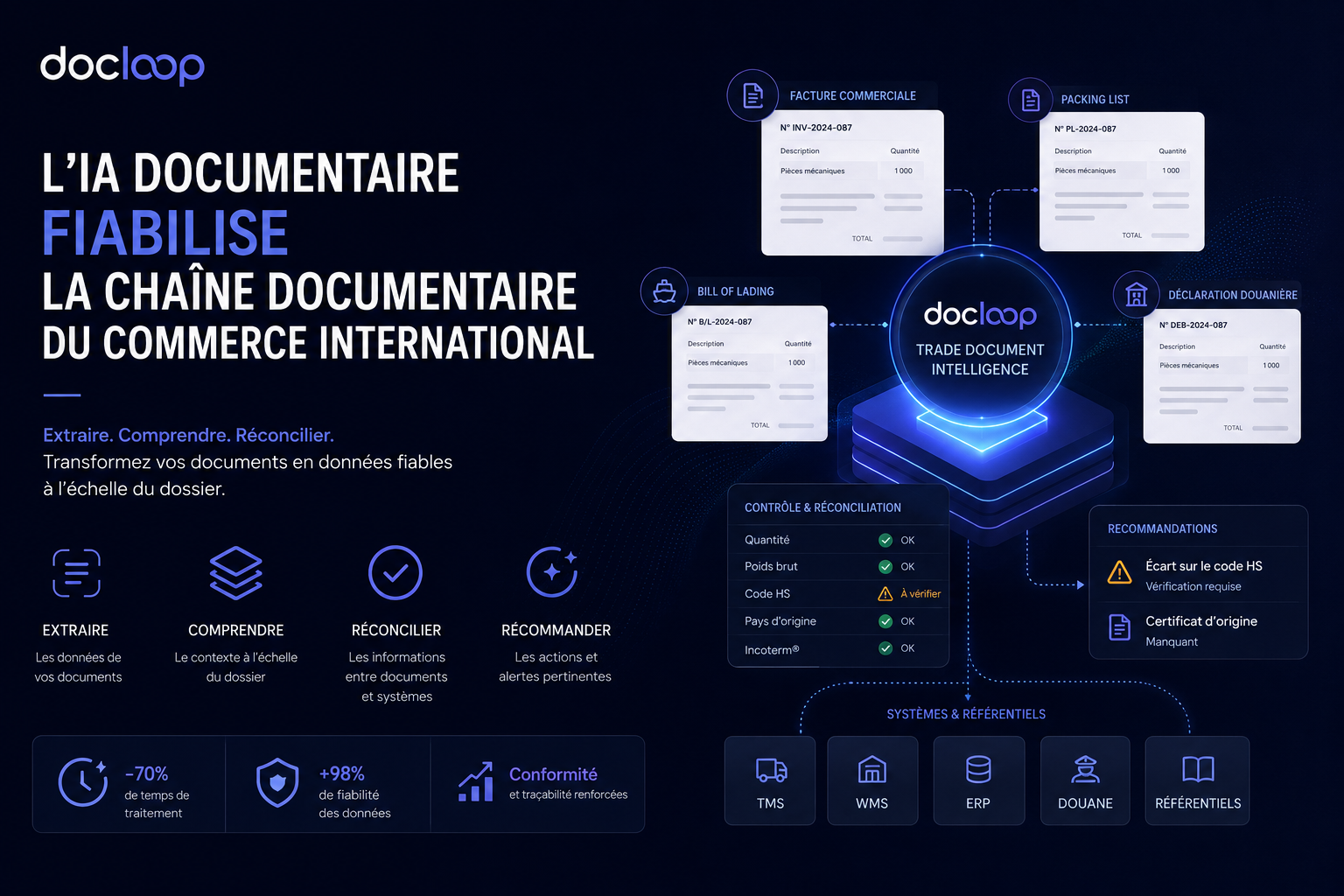
An international shipment can involve up to 16 steps, from negotiating the Incoterm® to delivery to the recipient. But it also generates between 20 and 40 documents: commercial invoice, packing list, bill of lading, DAE, certificates of origin, letter of credit, customs documents, and proof of delivery.
Even today, a large portion of these documents is re-entered and reconciled manually.
Document-based AI, or IDP ( Intelligent Document Processing ), is a game-changer. It reads all types of documents, extracts structured data from them, reconciles information from multiple sources, and verifies both consistency and compliance.
The range of use cases and levels of control that are emerging is vast. It could profoundly transform the way companies in the transportation, logistics, customs, and international trade sectors manage their documents.
Throughout the entire supply chain—pre-shipment, international transport, and post-shipment—each party generates or receives documents.
An inspection certificate, packing list, customs declaration, ocean bill of lading, LTA or CMR, customs invoice, certificate of origin, certificate of circulation, export license, bill of lading, and cargo insurance round out this set of documents.
The problem is simple: these documents often contain duplicate data.
Item references, quantities, weights, values, currencies, or Incoterms® are available in various formats. Teams re-enter this data into a TMS, a customs system, or a spreadsheet, and then compare it with each other or with multiple systems and databases.
Yet even a simple discrepancy can have significant consequences.
A payment may be held up. UCP 600 rules may allow a bank to reject a documentary credit due to a reservation, even a minor one. A customs filing may require additional verification. A freight invoice may differ from the negotiated rate terms.
Document reliability therefore becomes a prerequisite for payment, customs clearance, compliance, and operational performance.
The real challenge is no longer simply reading a document. It is determining whether the information contained in the entire file is consistent, complete, and actionable.
Document-based AI serves three complementary purposes: automating data entry, enabling documents to “communicate” with one another, and ensuring compliance.
The first step involves automatically converting the information contained in documents and emails into structured data.
For example, AI can:
The goal is to eliminate repetitive data entry while reducing the risk of human error.
But extraction is only the first step.
An international operation is never based on a single document.
A commercial invoice contains quantities and values. A packing list details the packages and weights. A bill of lading contains information related to transportation. A customs declaration includes some of this information in a different format.
The second use case, therefore, involves automatically matching multiple documents.
Documentary AI can, in particular, compare:
This ability to reconcile information is essential, because the most significant errors do not necessarily occur within a single document. They often arise when multiple sources describe the same operation differently.
The third step is to verify that the information in the file is consistent and complies with the applicable requirements.
In particular, AI can:
The system no longer simply answers the question:
What is in this document?
It also seeks to answer a more complex question:
Is the information contained throughout the file consistent, complete, and usable?
Not all inspections are created equal.
They can be classified on a maturity scale ranging from the simplest form of data integration to business intelligence that learns from experts.
The first step is to verify that the same data is exactly the same across documents.
This may apply to:
This check makes it possible to quickly identify direct contradictions between multiple documents.
The second level goes a step further.
It is no longer just a matter of verifying that two values are identical, but of linking two documents using a common key—such as a part number or a package number—and then performing validation checks.
The system can thus verify that the sum of the quantities matches the invoice or that the net weight listed on several lines matches the declared total.
The logic then becomes relational: the documents are cross-referenced to reconstruct a coherent picture of the operation.
The third step involves comparing the information in the file with public or regulatory standards.
This may include:
At this stage, the data is no longer merely consistent with the other documents in the file. It must also comply with the applicable requirements.
The fourth step involves comparing the documentary data with the company's internal standards.
These may include:
Does the shipping invoice match the quote? Does the unit price comply with the contract? Was the additional service that was billed included in the contract?
This level is particularly valuable because it automatically detects pricing discrepancies, overbilling, or non-compliance with terms and conditions.
The fifth level is based on leveraging human expertise.
The expert validates, corrects, and refines the rules. The system learns from these decisions and gradually feeds this expertise back to the team and the company.
The goal is not to eliminate the expert, but to transform their expertise into reusable, explainable, and auditable business intelligence.
The tool thus improves over time by learning from the decisions and corrections made during actual operations.
Documentary AI can process both structured and unstructured documents.
In the fields of transportation, logistics, customs, and international trade, this may include, among other things:
Recent technologies can adapt to variable layouts, handle multiple languages, and gradually learn from corrections.
But simply reading a document isn't enough.
The real challenge lies in understanding how this information relates to the information in the other documents in the same file.
No.
Documentary AI primarily eliminates repetitive tasks such as reading, extracting, retyping, and matching.
This allows experts to refocus their efforts on situations that truly require their involvement: arbitration, consulting, reviewing complex cases, and decision-making.
AI documents, alerts, and makes recommendations.
Decisions remain human-driven when the context, the level of risk, or the complexity of the case so require.
This human oversight is particularly important in customs, regulatory, and financial operations, where automation without monitoring or traceability can create new risks.
The benefits depend on the process, the complexity of the documents, and the desired level of automation.
The initial feedback from operators mentioned in the original article includes the following:
However, the issue is not limited to the time saved.
Automation also enables teams to process more cases, reduce repetitive tasks, and devote more time to high-value-added activities.
The best place to start is usually the most repetitive, time-consuming, or tedious part of the documentation process.
These may include, for example:
The goal is not necessarily to immediately automate the entire document management process.
A phased approach allows you to start with a specific use case, measure the benefits achieved, and then extend automation to reconciliations and regulatory or contractual controls.
You climb the stairs one step at a time.
By automating reading, matching, and verification, document-based AI does not eliminate jobs—it adds value to them.
The freight forwarder becomes responsible for ensuring compliance. The customs team focuses on handling exceptions rather than seizures. The company captures its expertise in reusable and auditable rules.
The players who will succeed are those who gradually climb the ladder of controls: from simple data extraction to data reconciliation, then to regulatory and contractual verification, and finally to leveraging human expertise.
Each document then ceases to be a standalone piece.
It becomes a reliable, traceable, and admissible source of data within a comprehensive case file.
It is this transformation that paves the way for a new generation of document-based AI in logistics and international trade: AI that no longer merely reads documents, but helps to enhance the reliability of the entire document file.